St Oswald’s House
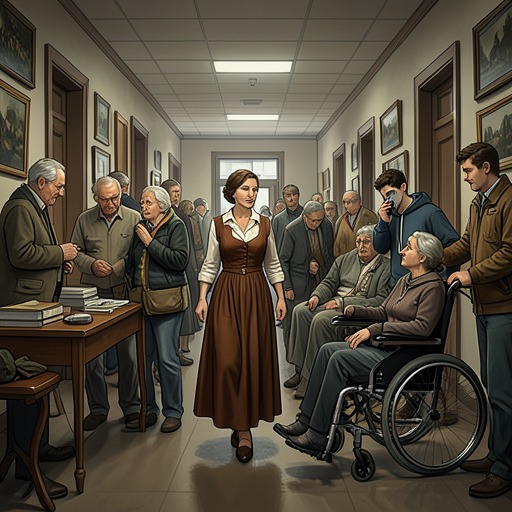
Bridget Jones: Mad About the BoySt Oswald’s House is an upscale residential complex near Kettering where Bridget Jones’s Mother and Una have moved, and its carefully curated world repeatedly spills into Bridget Jones’s family life. Built around a grand Victorian mansion, the establishment combines a stately-home atmosphere with branded restaurants, leisure facilities, and organized ceremonies. For Bridget, it is at once her mother’s new home, a potential source of help with the children, and the setting for social occasions whose elaborate arrangements rarely match the disorder she brings with her.
Setting and Facilities
The complex is centered on a grand Victorian mansion described as almost a stately home. Its grounds include a lake and wildlife, the latter presented in the promotional language as rare, though Bridget punctures the grandeur by reducing the wildlife to squirrels. The Italianate garden, designed by Russell Page in 1934, gives the landscaped grounds a specific historical distinction.
The facilities are presented as a small, self-contained world. Dining options include BRASSERIE 120, a bar and bistro; CRAVINGS, the more formal restaurant; and CHATS, a coffee bar. There are function rooms, guest suites for visiting families, and a collection of houses and bungalows described as superbly appointed. VIVA adds a pool, spa, gym, beauty salon, hairdresser, and fitness classes. The abundance of amenities helps explain why the establishment can serve not just as a home but as the center of its residents’ schedules and celebrations.
The family’s insistence that it should not be called a retirement community sits in comic tension with the visible structure of the place: organized facilities, resident activities, and a community designed to accommodate older people. Its polished vocabulary and branded amenities soften the idea of retirement without making the underlying fact disappear. Bridget’s phone calls with her mother repeatedly bring this managed world into contact with the demands of childcare and family life outside it.
Bridget’s Mother and Una at Home
After Bridget’s Mother and Una move in, their calls to Bridget often revolve around the complex’s activities. One call begins with a baffling account of Una’s cranio-facial appointment, her newly styled hair, and the timing of Aqua-Zumba. The details convey a life organized around appointments and leisure facilities, while Bridget, at home with her children, struggles to follow the conversation or find space for her own concerns.
The move also follows a history of bereavement. Bridget recalls that her father died of lung cancer six months after diagnosis, though he lived long enough to hold newborn Billy. Una had still had Geoffrey, her husband and a close friend of Bridget’s parents for fifty-five years, until his heart attack. Bridget observes that her mother and Una now rarely show their grief, and describes them as belonging to a wartime generation able to carry on cheerfully. St Oswald’s House thus becomes the setting for a contrast between the older women’s busy routines and the losses that underlie them.
Bridget’s Mother urges her widowed daughter to have fun and suggests that she visit to join her and Una in the sauna. The invitation is kindly meant, but its impracticality is plain to Bridget: it would require leaving the children, driving for an hour and a half, and joining the older women’s beauty and spa routine. The exchange captures a recurring mismatch between the mother’s model of cheerful activity and Bridget’s immediate responsibilities as a single parent.
Christmas Plans and Caregiving
The complex’s social life shapes the family’s Christmas arrangements. Bridget’s Mother and Una propose taking Bridget and the children on the St Oswald’s House cruise to the Canaries. The trip is advertised as suitable for people over fifty, not exclusively older residents, and offers visits to lively destinations. Bridget briefly imagines that spending time among older holidaymakers might make her feel young; then she pictures herself chasing Mabel across a cruise-ship deck through bouffant hairstyles and electric wheelchairs. When her mother clarifies the age limit, Bridget’s enthusiasm collapses.
The planning becomes more difficult when Bridget’s Mother and Una offer to come to Bridget’s house instead. Bridget remembers the previous Christmas, when she tried to manage Santa without Mark Darcy and cried behind the kitchen counter, while the older women argued over gravy and criticized her parenting and housekeeping. The memory makes the choice more than a question of holiday preference: Bridget fears repeating a painful Christmas while also lacking the help she needs. Her friend Magda advises her to bring the children to Gloucestershire, where neighbors have children of similar ages and there is little to spoil. Magda urges her to tell her mother that they can celebrate at St Oswald’s House after the cruise.
That alternative works. Bridget’s Mother is content with a post-Christmas celebration at the complex and enjoys the cruise, calling to talk about Pawl, the pastry chef, and a man who entered other passengers’ berths. Bridget and the children instead spend Christmas Eve and Christmas Day with Magda and Jeremy. The holiday includes making stockings, wrapping the large pile of presents ordered from Amazon, and time spent going between Rebecca’s home and Bridget’s with pans of burnt food. Billy has few memories of Christmas with Mark, and Mabel has never experienced one with him; the successful arrangement gives the children a warm holiday without requiring the original cruise plan.
The Hard-Hats-Offing
St Oswald’s House also stages ceremonies for its building projects. When the new Gatehouse Lodges are completed, the complex holds a Hard-Hats-Offing: residents wear hard hats and toss them into the air. The event is announced as a regular practice across the St Oswald’s establishments, turning construction into a communal celebration. Bridget is invited because her mother expects the family to attend, and the gathering is timed around speeches and lunch.
On Saturday, January 26, 2013, Bridget arrives at 12:59, just before the one o’clock speeches. The grounds have been transformed into a combination of show-home event and royal tree-planting ceremony, with red-and-white Thornton Gracious Living flags, red balloons, white wine, and staff in formal suits holding clipboards. The arrangement is immaculate; Bridget and the children arrive in a state of domestic disarray. Mabel is wearing a heart-covered dress sent by her grandmother, after Bridget has struggled to change her out of glittery clothes and leggings.
The ceremony’s carefully managed atmosphere breaks down when Bridget hands Mabel a basket of chocolate hearts. Mabel drops it on the gravel; Billy steps on the chocolates; Mabel cries, and Billy soon cries too. The speech stops as the crowd turns to look. Bridget’s Mother and Una hurry toward them in matching pastel outfits, while Bridget gathers Mabel up and finds chocolate smeared between the child’s dress and her own coat. The scene makes the complex’s formal sociability a sharp foil for the family’s messy arrival: even a ceremony designed around novelty hats and orderly celebration becomes a public caregiving crisis.
A Community That Organizes Family Life
St Oswald’s House repeatedly appears as more than a backdrop because its facilities and activities affect the practical choices Bridget must make. The Christmas cruise occupies one branch of her holiday planning; the hard-hat ceremony brings her children into the establishment’s public social world; and the fitness schedule can compete with the informal childcare she hopes to secure. After a later family disaster, Bridget finds that her mother is unavailable to babysit because she has Aqua-Zumba, while Magda is away on a short break. The leisure timetable that makes life at the complex attractive to its residents is not automatically a childcare resource for Bridget.
The location’s comedy depends on the contrast between presentation and lived experience. Its language promises rare wildlife, superbly appointed homes, and named destinations for dining and exercise; Bridget encounters appointment confusion, difficult holiday negotiations, dropped chocolates, and the limits of her family’s availability. Yet the complex also offers a place where her mother and Una have an active life after bereavement, and where a postponed Christmas celebration can succeed. St Oswald’s House is therefore both a polished institution and a real family setting: its routines create friction, but they also give Bridget’s mother and aunt a community of their own.